
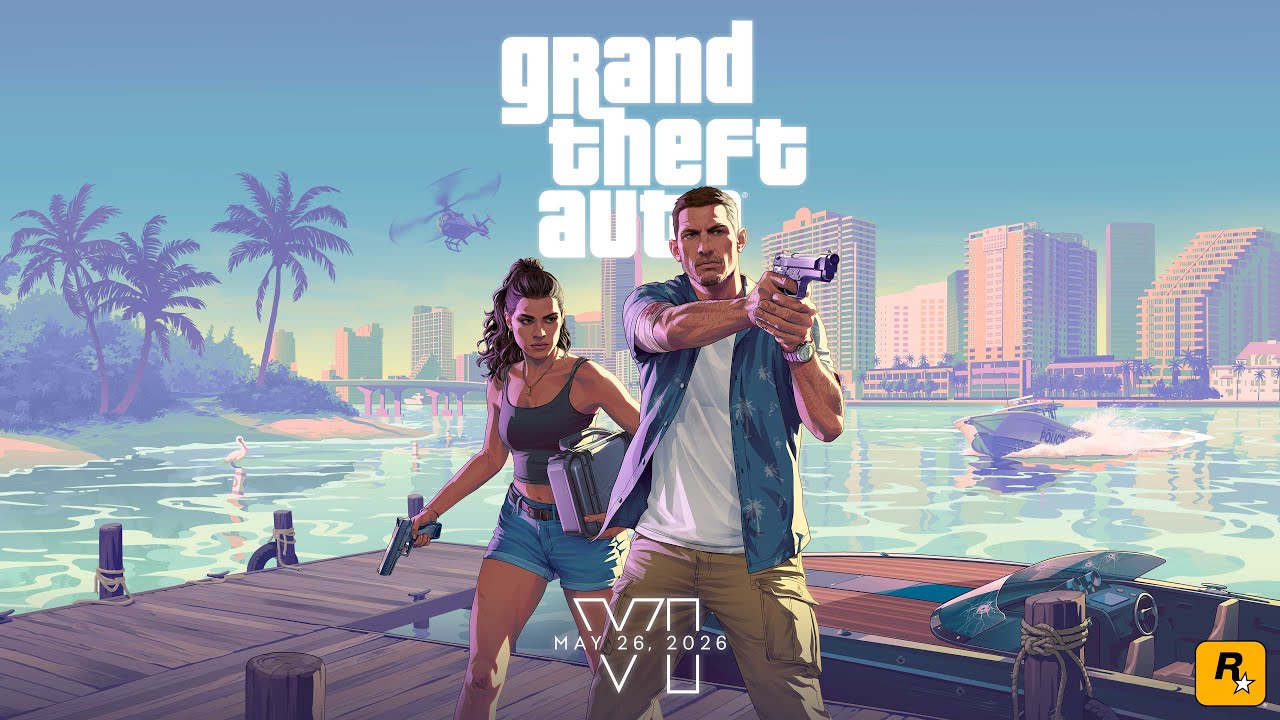
Watch: See Leonida in Motion (Trailer 2)
TL;DR
- Setting: Leonida — a fictional state inspired by present-day Florida
- Primary metropolis: Vice City returns, 24 years after its 2002 debut
- Confirmed regions (from Trailer 1): beaches, urban Vice City, suburbs, Everglades-style swamps, rural inland
- Map size: unconfirmed; widely expected to be the largest in the series, exceeding GTA V’s combined Los Santos + Blaine County
- Time period: modern day
What is Leonida?
Leonida is the fictional U.S. state where Grand Theft Auto VI takes place. It’s a thinly veiled stand-in for Florida — sun-warped, swampy, neon-saturated at night, full of contradictions Rockstar’s writers love to weaponize. The name first surfaced in Rockstar’s December 2023 Newswire announcement that revealed the game, and it’s been the official setting reference ever since.
Where San Andreas was Rockstar’s take on California and Liberty City stood in for New York, Leonida is their Florida — and the team is leaning into every visual, cultural, and political signal that comes with that.
Vice City returns
The centerpiece of Leonida is Vice City, Rockstar’s Miami analog. This is significant for any longtime GTA player: Vice City was the setting of Grand Theft Auto: Vice City (2002) and the spinoff Vice City Stories (2006). Trailer 1 confirms a full return to this map — modernized from the 1980s neon-noir aesthetic of the original to the present-day reality of South Florida.
Visual continuity from the 2002 game appears intentional. The geography, the beach-lined waterfront, the high-rise skyline — they’re recognizably the same Vice City, aged 24 years.
For fans who played the original on PS2, returning to Vice City is the kind of nostalgia hit Rockstar has used before. For new players, it’s a city designed from the ground up with the architectural and cultural specificity Rockstar is known for.
Confirmed environments from Trailer 1
A frame-by-frame look at Trailer 1 reveals several distinct biomes within Leonida:
Coastal Vice City
The iconic beachfront and high-rise skyline of Vice City Beach — neon at night, palm-lined and pastel by day. This is where the trailer opens.
Suburban districts
Tract housing, gated communities, strip malls. The kind of suburban sprawl that defines South Florida outside the city core.
The Everglades (or its Leonida equivalent)
Multiple shots in the trailer show airboats cutting across swamp water, alligators on shores, and dense subtropical vegetation. This is a meaningful gameplay environment — not just a backdrop.
Rural inland
Open fields, agricultural land, small-town gas stations and diners. Echoes of Trevor’s Sandy Shores in GTA V, but distinctly Floridian.
Trailer parks and waterfront communities
Shots of working-class housing, marinas, and waterfront mobile home communities — Lucia’s introduction takes place in this environment.
Real-world inspirations
Rockstar’s world-building approach is to take real places and remix them, rather than 1:1 copy. Here’s the educated map:
| Leonida region | Real-world inspiration |
|---|---|
| Vice City | Miami (especially South Beach, Brickell, Wynwood) |
| Vice City Beach | Miami Beach / Ocean Drive |
| The Everglades equivalent | Everglades National Park |
| Northern Leonida (rural) | Florida Panhandle, North Florida small towns |
| Coastal Keys-style areas | Florida Keys |
| Strip Mall / suburban sprawl | Orlando exurbs, Broward County |
There are likely Tampa, Orlando, and Jacksonville analogs as well, though none have been explicitly confirmed in marketing yet.
Map size predictions
Rockstar has not officially stated GTA 6’s map size. What we know:
- GTA V’s map (Los Santos + Blaine County) is approximately 75 square kilometers in total
- Red Dead Redemption 2’s map is approximately 75 square kilometers
- Dataminer estimates and insider reports suggest GTA 6 may be significantly larger — potentially the largest Rockstar map ever
- The variety of environments shown in Trailer 1 (urban, suburban, swamp, rural, coastal) supports a larger map
Final size will only be confirmed at launch or in pre-release marketing closer to November 2026.
How Leonida compares to past GTA settings
| Game | Setting | Real-world | Map style |
|---|---|---|---|
| GTA III (2001) | Liberty City | New York City | Single dense city |
| Vice City (2002) | Vice City | Miami (1980s) | Single city with islands |
| San Andreas (2004) | San Andreas state | California + Nevada | Three cities + countryside |
| GTA IV (2008) | Liberty City | New York City | Single dense city |
| GTA V (2013) | San Andreas (redux) | California | One city + open country |
| GTA VI (2026) | Leonida | Florida | State-spanning, multi-region |
Leonida’s structure most closely resembles San Andreas (2004) — a multi-region state with a primary metropolis plus rural and natural areas. The scope appears more ambitious than GTA V’s relatively compact Los Santos + Blaine County combo.
Differences from GTA V’s setting
For players coming off GTA V, here’s the at-a-glance shift:
- Climate: California sun (V) → Florida sun-and-humidity (VI). Expect rain, lightning storms, and visible heat haze.
- Vegetation: scrubby desert (V) → subtropical, mangroves, palms, swamp grass.
- Water: Pacific Ocean coast (V) → Atlantic + Gulf + swamp + inland waterways. Boats matter a lot more.
- Wildlife: mountain lions, deer, coyotes (V) → alligators, manatees, flamingos, sharks.
- Urban feel: L.A. sprawl (V) → Miami density + Everglades wild edge.
What’s still unknown about the setting
- Total cities: Vice City is confirmed; speculation about a Tampa, Orlando, or Jacksonville equivalent is unconfirmed
- Interior depth: how many buildings are enterable
- Online integration: how Leonida is structured for GTA Online VI
- Story-spanning regions: which areas are tied to story missions vs. free-roam-only
- Time-of-day dynamics: day/night cycle implications for biome behaviors (e.g., swamp at night)
We’ll update this page as Rockstar reveals more.